


How We Score Junior Mining Stocks: The Atlas Evaluation System
Mining investment research has an information problem. Junior mining companies release drill results, resource updates, metallurgical studies, financings, permitting news, and construction updates every day. Each announcement may contain an important signal, but the headline rarely provides enough context to judge it.
The hard part is not finding more news. It is turning fragmented disclosures into comparable evidence without losing the geology, project stage, jurisdiction, or capital structure that gives each fact meaning.
Atlas is how we are systematizing that work.
The Mining Investment Challenge
Mining disclosures are difficult to compare because companies report different facts, at different project stages, under different technical standards.
Consider two hypothetical gold explorers. One reports a narrow, high-grade intercept from an early discovery hole. The other reports a wider, lower-grade interval from an infill program designed to improve resource confidence. The first headline may look more exciting. The second may do more to reduce project risk.
The distinction is not visible in grade alone. An investor also needs the reported and true widths, drill orientation, depth, continuity, deposit model, program objective, metallurgy, and quality-control disclosure.
Reporting standards help, but they do not make every announcement directly comparable. NI 43-101 and JORC disclosures can differ in format and detail. Companies also emphasize different metrics. One may lead with grade, another with contained metal, and another with a percentage increase from an earlier estimate.
Good mining due diligence therefore requires a consistent way to move from announcement to fact, from fact to context, and from context to an investable research question.
How We Extract and Score Mining Data
Atlas follows three steps—extract, assess, and aggregate.
1. Extract
Each disclosure is broken into structured facts. A drill announcement might yield grade, interval length, depth, hole type, orientation, and program objective. A resource update might yield tonnage, grade, contained metal, confidence category, cut-off assumptions, and changes from the previous estimate.
The aim is to preserve the source detail. Every assessment should remain traceable to the document and fact that produced it.
2. Assess
Each fact is then considered through several lenses:
- Direction: Is the disclosed development positive, negative, or neutral in context?
- Materiality: Could it meaningfully change the technical or economic view of the project?
- Technical quality: Is the evidence complete, professionally reported, and suitable for the conclusion being drawn?
- Recency: How much weight should current information carry relative to older disclosures?
This is not a shortcut around technical judgment. The same copper grade can mean different things in a large porphyry system and a narrow, higher-grade deposit. Context determines the useful comparison set.
3. Aggregate
Individual facts are combined into broader views. Think of a mosaic: each tile is still visible, but the assembled picture reveals patterns that no single announcement can show.
That structure allows Atlas to compare evidence across time while preserving the route back to the original disclosure.
Scoring Dimensions: Analyzing Gold, Copper and Silver Mining Stocks
The same structured evidence can answer different questions depending on how an investor wants to view the market.
By company
How is the evidence around one company changing? A company view brings drill results, resources, metallurgy, financing, permitting, and execution into one timeline. It can show whether technical progress is being supported by financial runway and whether new disclosures strengthen or weaken earlier assumptions.
By commodity
What patterns are appearing across gold mining stocks, copper mining stocks, or another commodity? Commodity views help separate a company-specific development from a broader change in disclosure or market narrative. They also make comparisons more relevant: gold grade is evaluated against gold context, not a generic mining threshold.
By region
How do comparable projects differ across jurisdictions? Regional views can surface differences in permitting progress, infrastructure, community engagement, political risk, and development timelines. A technically similar deposit can face a very different route to construction in Nevada, Quebec, Chile, or Peru.
By event type
Are drill results improving while financing quality deteriorates? Are resource updates becoming more credible while permitting progress stalls? Separating disclosures by event type prevents a flood of promotional news from obscuring a weak signal in the category that matters most.
By combinations
The dimensions can also be combined. An analyst may want to compare copper-project financing in two regions, or the quality of gold-resource updates over a defined period. One extraction supports many lenses. That is more useful than building a different spreadsheet for every question.
The Eight Evaluation Categories: From Drill Results to Construction
Atlas evaluates evidence across the full mining lifecycle, not only the announcement types that generate the strongest headlines.
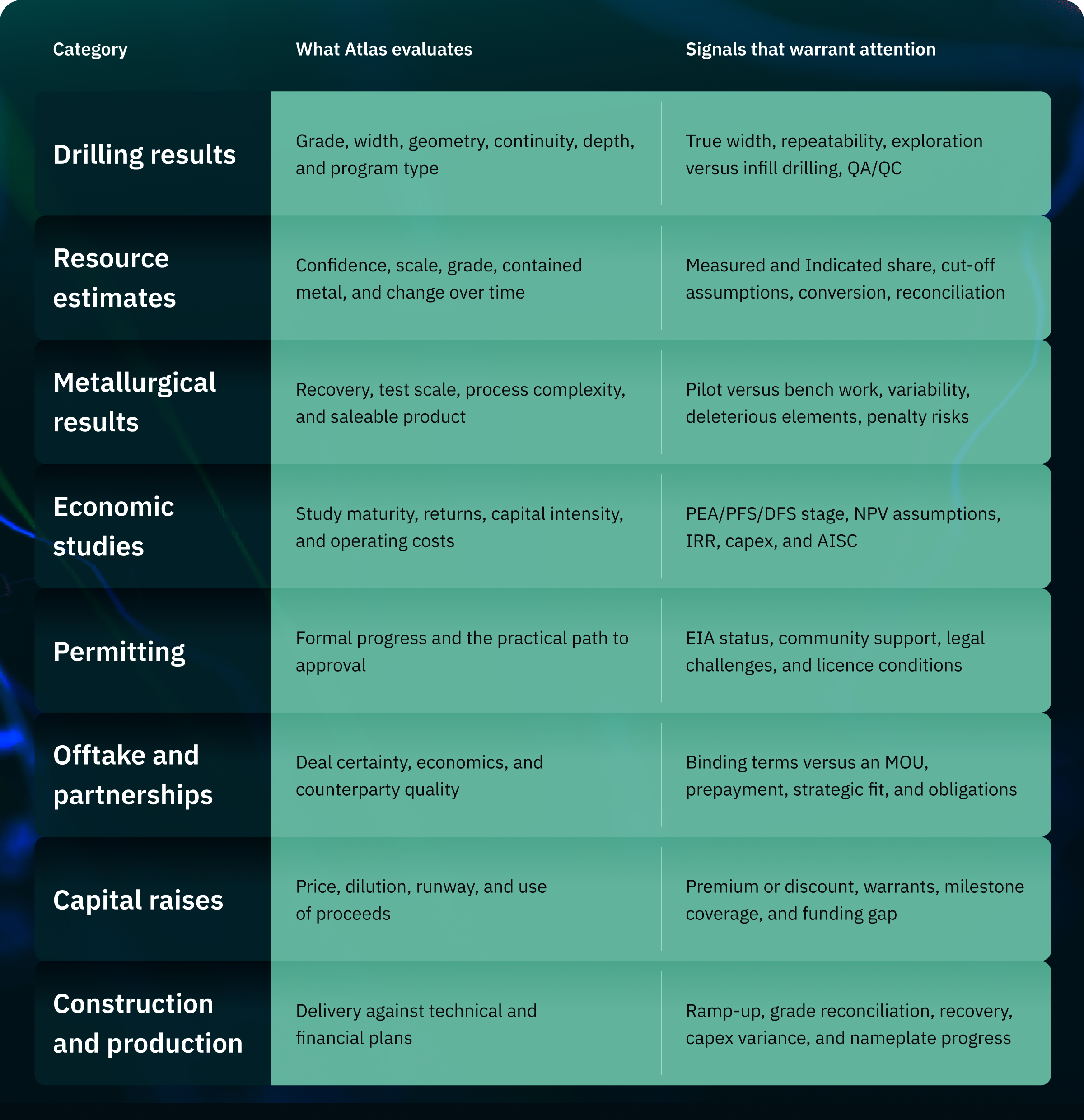
Each category can be described through five tiers: Exceptional, Strong, Moderate, Weak, and Red Flag. These are not universal numerical cut-offs. Thresholds need to reflect the commodity, deposit type, mining method, project stage, and jurisdiction.
Drilling illustrates why. Grade times width can identify an intercept worth investigating, but a narrow vein and a broad porphyry can produce a similar result while implying different mining methods and economics. Our published guide to evaluating mining drill results explains true width, continuity, depth, metallurgy, and program objectives in more detail.
Economic studies require the same care. A PEA, PFS, and DFS do not carry the same level of confidence. NPV, IRR, capex, and all-in sustaining cost are only as useful as the assumptions underneath them. Our guide to the mining exploration process and AISC provides the broader project-stage context.
What Makes a Score: Direction, Materiality and Quality
Atlas asks what happened, whether it matters, how credible the evidence is, and how current it remains. Direction captures whether a fact strengthens or weakens the current view. Materiality separates a potentially valuation-relevant development from routine activity. Technical quality tests whether the disclosure supports the claim. Recency prevents stale evidence from carrying the same weight indefinitely.
These elements contribute to an effective score, but the underlying evidence remains visible. An analyst should be able to understand why an assessment changed and inspect the source facts behind that change. That traceability matters when signals conflict. A positive drill result may be technically strong but immaterial to the current resource. A large financing may extend the runway but introduce substantial dilution. A permitting announcement may sound positive while leaving the central approval unresolved. A useful score does not erase those distinctions. It organizes them.
Finding Undervalued Mining Stocks: Fundamentals vs Narrative
Atlas separates what the disclosed evidence supports from how the market is being encouraged to interpret it. The fundamentals view focuses on evidence: drill geometry, resource confidence, recovery, costs, permitting progress, financing terms, and execution.
The narrative view focuses on presentation: the language of the release, the prominence given to selected facts, and the themes repeated across the company's communications. Imagine a company announcing a "transformational" drill result. The fundamentals may show a high-grade interval, but also uncertain true width, limited continuity, and no change to the resource model. That is a positive narrative running ahead of incomplete evidence.
The opposite can happen as well. A methodical infill program or a modest-looking metallurgical update may materially reduce development risk without generating an exciting headline. Divergence is not proof that a security is undervalued or overvalued. It is a research signal: a reason to investigate where perception and evidence may not yet align.
Quality Controls: Context, Red Flags and Verification
Quality controls are designed to stop unlike facts from being treated as equivalent.
First, thresholds are context-specific. A grade cannot be labelled strong or weak without considering the commodity, deposit style, depth, geometry, recovery, and likely mining method.
Second, Atlas looks for missing or inconsistent disclosure. Examples include an intercept without structural context, a metal-equivalent grade without transparent assumptions, a stale resource presented as current, or a metallurgical result that omits variability and penalty elements.
Third, technical sign-off matters. Qualified Person or Competent Person disclosure, appropriate laboratories, chain of custody, blanks, standards, duplicates, and historical comparability all help determine whether the evidence supports the claim.
Our geology team validates the technical framework and reviews the cases where automated structure cannot replace professional judgment. Atlas is designed to support that diligence, not to bypass it.
The Company Conviction Score: AISC, Catalysts and Capital Structure
The Company Conviction Score brings the most decision-relevant evidence into a single factor view without hiding what drives it.
The framework considers nine factors:
- Drill Quality
- Resource Quality
- Financial Health
- Management
- Jurisdiction
- News Sentiment
- Price Momentum
- Catalysts
- Institutional Backing
Each factor is normalized on a 0–100 scale before aggregation. Not every factor comes from company news. Price momentum requires market data. Jurisdiction needs a broader risk view. Institutional backing draws on filings and ownership evidence.
Four factors are especially useful when reviewing junior mining stocks. Drill Quality tests whether new results add credible geological evidence. Resource Quality examines confidence, scale, and change over time. News Sentiment summarizes the direction of disclosed developments. Catalysts identify the milestones that could materially change the project view.
The result is not a list of the "best mining stocks," a price target, or a substitute for an investment committee. It is a structured way to screen a large market, identify the factors driving an assessment, and direct analyst time toward the questions that need deeper work.
What Atlas Enables
Atlas turns a large, uneven disclosure stream into a traceable research workflow.
It can help investors and analysts compare companies on consistent dimensions, monitor changes across a portfolio or watchlist, and identify developments that deserve timely review. It also makes the research process more explicit: every high-level view should lead back to the facts and documents that support it.
This is the overview for a series of category deep dives. We have already published our methodology for evaluating mining drill results. Future articles will cover resource estimates, metallurgy, economic studies, permitting, offtake and partnerships, capital raises, and construction and production.
The goal is not to replace mining expertise with a number. It is to make the evidence easier to compare, the assumptions easier to challenge, and the next diligence question easier to find.
This article is for educational purposes only and does not constitute investment advice, an offer, or a recommendation. Mining investments involve substantial risk. Any access to future opportunities is subject to investor eligibility, KYC requirements, applicable law, and jurisdiction.