Mining Exploration Process Explained: Junior Mining, Grades, AISC & Big Exits
Contents
The mining exploration process sits at the front end of the mining value chain. This is where junior mining companies operate, discovering new mineral deposits and defining resources before development begins. Unlike major mining companies, junior mining companies are small-cap explorers, often listed on exchanges like the TSX Venture Exchange (TSX-V) or the Australian Securities Exchange (ASX). Their role is straightforward: discover mineral deposits, define resources, and progress projects until they become attractive to larger operators. Understanding how junior mining works requires looking at three things: exploration, project economics, and how value is ultimately realised.
What is Junior Mining and How Does it Work?
Junior mining companies focus on early-stage exploration, raising speculative capital, typically through equity, and deploying it into discovering and defining mineral resources across prospective regions. Their business model is not built on production or steady cash flow, but on discovery, resource definition, and progression through key milestones that increase project value over time. If successful, a junior mining company can exit through acquisition by a major mining company, a joint venture or earn-in agreement with a larger operator, or a direct asset sale depending on the stage and quality of the project. This is where outsized returns can occur, as early investors take on exploration risk in exchange for exposure to potential revaluation when a viable mineral deposit is proven and attracts serious development capital.
Mining Exploration Process: From Prospecting to Drilling
The mining exploration process is structured but inherently uncertain. Juniors deploy capital across four main activities.
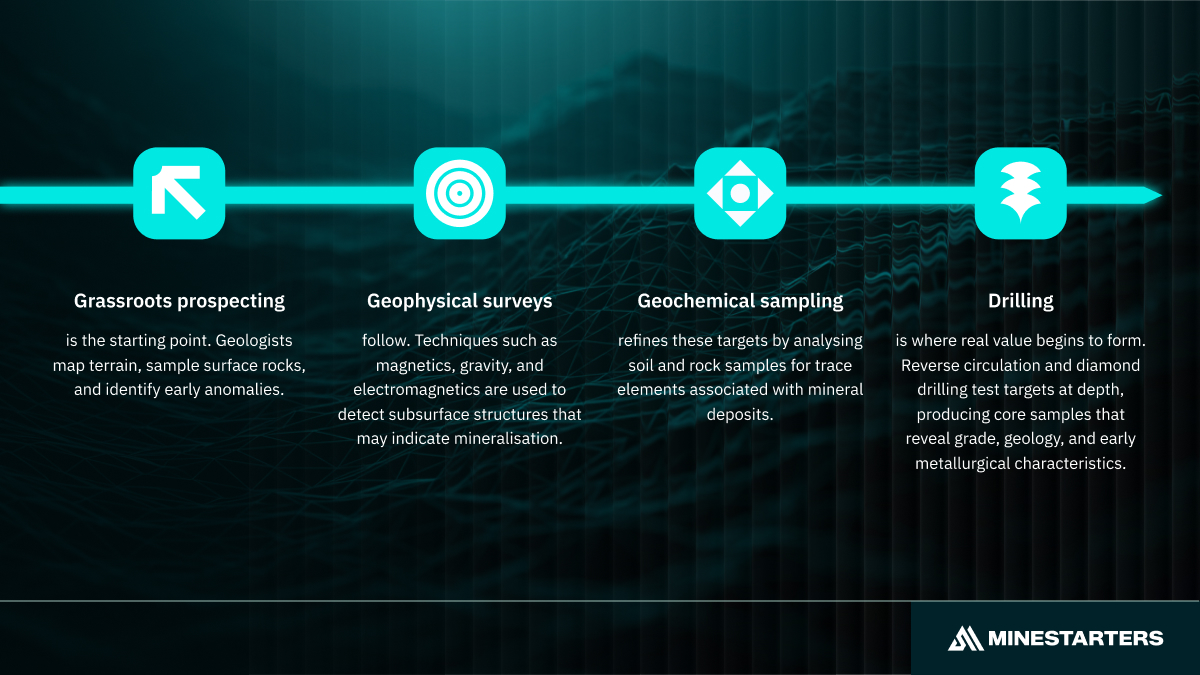
Each stage reduces uncertainty, but most exploration projects do not progress beyond this phase.
What Makes a Mining Project Economically Viable
Discovery alone is not enough. A deposit must meet specific economic criteria to be viable.
Key factors include:
- Tonnage, or the total volume of mineralised material
- Grade, which measures metal concentration, such as grams per tonne for gold or percentage for copper
- Metallurgical recovery, which determines how much metal can actually be extracted
- Depth, as shallower deposits are typically cheaper to develop
- Geometry, which affects how efficiently the deposit can be mined
For example, a gold project may need grades above 0.5 to 1 g/t for open-pit mining, while high-grade deposits above 5 g/t attract strong interest. Copper projects often require 0.2 to 0.4 % for bulk deposits, with higher-grade zones above 0.7% considered more attractive. If these conditions are not met, even visible mineralisation may never become a mine.
Mining Grades, Tonnage and Recovery in the Exploration Process
Grade, tonnage, and recovery define the core economics of a mining project. Grade determines how much metal is present. Tonnage determines scale. Recovery determines how much of that metal can be processed into a saleable product. A project with moderate grade but large tonnage can still be viable. Conversely, a small but very high-grade deposit may also work, particularly for underground mining. Recovery is often overlooked but critical. A project with 90% recovery has a materially different economic profile than one at 70%, even if grade and tonnage are similar. These variables feed directly into valuation models and feasibility studies.
Mining Feasibility Studies After the Exploration Process
Once a discovery shows promise, projects move into development studies.
The progression typically follows:
- Scoping study, which provides an initial economic view
- Pre-feasibility study (PFS), which refines technical and financial assumptions
- Definitive feasibility study (DFS), which provides a detailed plan for development
At this stage, metrics such as net present value (NPV), internal rate of return (IRR), and cost assumptions become central. Investors often look for IRR above 15 to 20% and sufficient scale, such as 50 to 100 million tonnes for large copper or gold systems.
Only a small percentage of projects reach this stage.
What is AISC and Why Does it Matter?
All-in sustaining cost, or AISC, is one of the most important metrics in mining economics. It represents the full cost of producing one unit of metal, including:
- operating costs such as mining and processing
- general and administrative expenses
- royalties and taxes
- sustaining capital and ongoing development
- reclamation and closure obligations
By-product credits are deducted, which can lower the effective cost. AISC provides a clearer view of profitability than simple operating cost metrics. If gold is priced at $2,000 per ounce and AISC is $1,200, the margin is $800 per ounce. Lower AISC generally indicates a more competitive and resilient project.
How Junior Mining Companies Make Money
Junior mining companies do not typically generate revenue from production. Instead, they create value by proving and expanding mineral resources, improving project economics through ongoing work and studies, and reducing technical and development risk as more data becomes available. As projects progress through these stages, their perceived value increases, which is reflected in company valuation and growing investor interest. Capital tends to flow into projects that demonstrate credible potential and measurable progress, rather than those that remain at a purely speculative stage.
How Mining Projects Exit to Major Companies
Most successful juniors do not become producers. Instead, they exit. Major mining companies such as BHP, Rio Tinto, and Newmont acquire advanced projects to replace depleted reserves and secure future production pipelines.

Exits typically occur through outright acquisition, joint ventures, or earn-in agreements, depending on the stage of the project and the strategic fit for the acquiring company. This is the point where value is realised, as early investors benefit from the re-rating that occurs when projects move from early-stage exploration into development-ready assets that meet the scale and economic thresholds required by major operators.
Understanding Junior Mining in Context
Junior mining is a high-risk, discovery-driven segment of the industry. It sits at the beginning of the mining value chain, where capital is deployed before certainty exists. Success depends on a narrow set of outcomes. Projects must meet thresholds in grade, tonnage, recovery, and cost. They must progress through structured development stages. They must ultimately attract interest from larger operators. Most projects fail to reach that point.
But when they do, they underpin the future supply of critical minerals and create the foundation for the entire mining industry. Understanding how junior mining works is not just about exploration. It is about recognising how risk, capital, and geology combine to create value long before a single ounce is produced.
Stay connected with Minestarters
We publish clear, practical insights on the mining exploration process, junior mining, and how structured approaches can improve access, transparency, and capital flow over time. For updates, new content, and ongoing discussions, follow Minestarters here:
Follow us here for updates:
Information in this article is for educational purposes and is not investment advice. Access to any future opportunities will be limited to qualified, KYC’d investors in line with applicable regulations.